
Workshops der Internationalen Jugendbegegnung Dachau
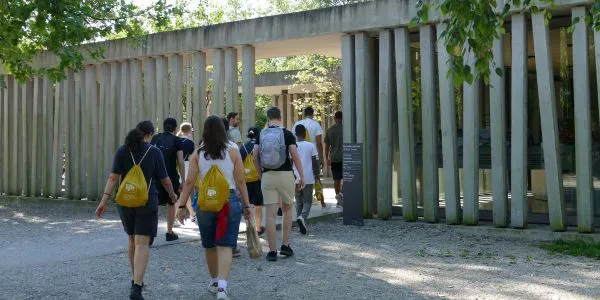
The International Youth Meeting Dachau (IYM) was funded in 1983 as Internationale Jugendbegegnung Dachau (IJB Dachau). Since then, every year young people from all over the world get together. They search for answers concerning questions of the past, the present and the future. As a participant you'll be able to meet eyewitnesses or their descendants, visit historical places and engage in workshops about historic and current forms of nationalism, exclusion and discrimination of minorities.
Every year we have a limited number of places in our workshops for external visitors. The workshops are held in English.
One-day workshops cost €10. Two-day workshops cost €20. This includes participation in the workshop and lunch (buffet) at the Max-Mannheimer Haus.
There are 3 places available per workshop.
Workshop topics 2026:
29. - 30.07.2026 (2-day-workshops):
- Through My Eyes: Writing War, Peace and Remembrance - This two-day creative workshop invites you to transform your unique perspectives and experiences into powerful, personal writing.
- Violence and survival during the holocaust – psychological explanations - How was it possible that so many people in Nazi Germany were part of a violent society? Why did so many ordinary individuals accept, support or participate in persecution and murder? How were the victims mentally able to go through such horrors? We will explore psychological explanations for these questions together.
29.07.2026
- Artists under totalitarian regimes - During our workshop, we will discuss how art and politics are closely tied together, and how artistic expression is often influenced by power structures, ideology, and social control.
- Forgotten stories of forced labor in Nazi Germany - We want to shine light on the stories of over 13 million people who were deported to Germany in the second world war and forced into labor.
- Persecution of queer people in Nazi Germany - We invite you to learn about a part of history that has often been overlooked, ignored or even denied in the remembrance of Nazi crimes: the persecution of homosexual and queer people during National Socialism.
30.07.2026
- How do we remember - different perspectives on the past - As part of the IYM Dachau program, you will encounter a diverse array of perspectives on what it means to remember. For those seeking deeper exploration of this vital field, we invite you to join our one-day workshop: "Developments of Cultures of Remembrance."
- Righteous Among the Nations - Individual solidarity: Are humans born with courage is it rather a skill that can be learned? We will explore the stories of different Non-Jewish people who helped Jewish people during the Nazi dictatorship despite the high risk for themselves.
- The holocaust in Eastern Europe - This workshop invites you to learn about the Holocaust beyond the most discussed narratives and to gain a deeper understanding of how genocide unfolded across Eastern Europe, commonly considered the center of mass extermination.
05.08.2026
- Antifeminism - In this workshop, we’ll not only explore the definition of Antifeminism but also talk about, where it comes from, and how it shows up in today’s politics and public debates around the world.
- Fighting for justice – young activism - We invite you to engage with different historical examples of activism (women’s rights movements, resistance during Nazi times).
- Righteous Among the Nations - collective solidarity - Why did some communities choose to risk everything and help Jewish people in Nazi Germany and its occupied territories? In our workshop we will follow those extraordinary stories of collective resistance and mutual responsibility during history's darkest moments.
- Stumbling stones - remembrance on our everyday paths - Stumbling stones are the biggest decentralized memorial for the victims of the Nazis. Everyone who was persecuted by the Nazis, regardless of the reason, can receive a stumbling stone as a memorial in front of the last freely chosen home they lived in.
- Warsaw Ghetto uprising - The Warsaw Ghetto Uprising is often considered to be the most successful instance of Jewish resistance against their perpetrators. Despite it being so well known in popular remembrance culture, there is little attention spent on how this struggle against certain death was even possible.
Termin
Mi, 29.07.2026 – Mi, 05.08.2026
Termin im Kalender speichern (ICS)
Ort
Max-Mannheimer-Haus
kostenlos
Contact:
Anja Schuller-Müller, anja.schuller-mueller@kjr-dachau.de
Anmeldeschluss: Mo, 27.07.2026 18:00 Uhr